
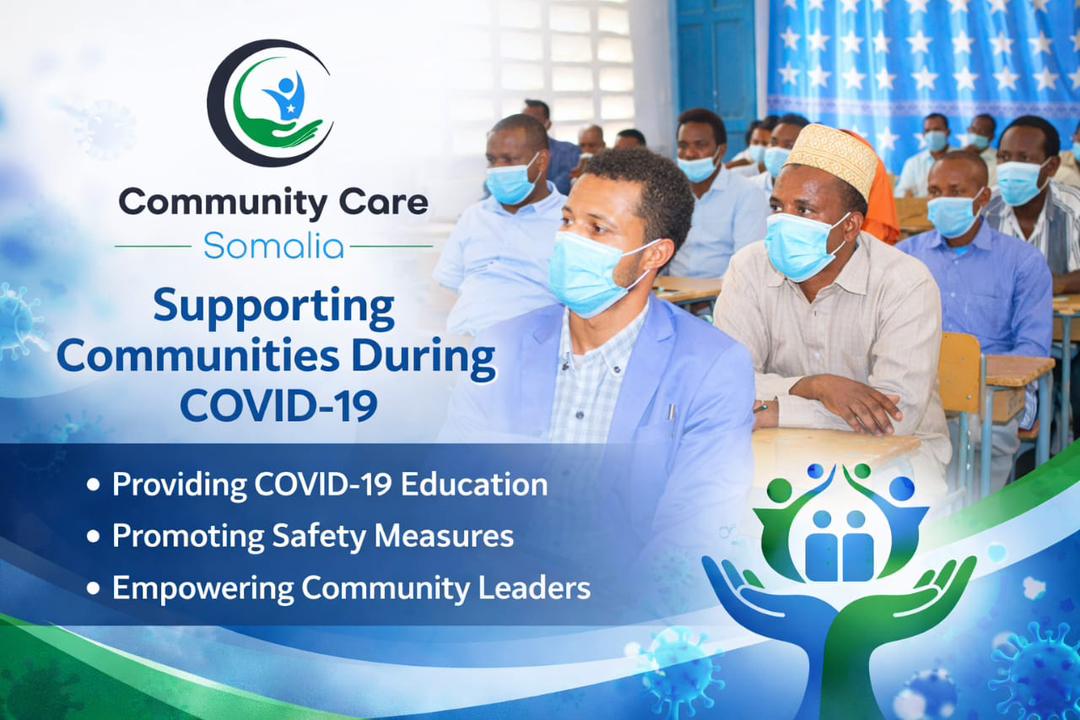
The COVID-19 pandemic exposed critical vulnerabilities in healthcare systems worldwide, particularly in developing regions where access to accurate information, preventive resources, and community leadership structures can be limited. The initiative highlighted in this image—Community Care Somalia—demonstrates a structured, community-centered approach to pandemic response that prioritizes education, safety, and empowerment.
A Community-Driven Response
At its core, Community Care Somalia focuses on mobilizing local communities to become active participants in public health efforts. Rather than relying solely on centralized interventions, this approach leverages grassroots engagement to ensure that information and resources are both accessible and culturally relevant.
The image reflects a training or awareness session, where participants—wearing protective masks—are engaged in what appears to be an educational workshop. This setting underscores a key principle: informed communities are resilient communities.
Key Pillars of the Initiative
1. Providing COVID-19 Education
Accurate information is one of the most powerful tools during a health crisis. Misinformation can spread as rapidly as a virus itself, leading to harmful behaviors and distrust. By organizing structured educational sessions, Community Care Somalia ensures that individuals understand:
- How the virus spreads
- Symptoms and early detection
- Preventive strategies
This empowers individuals to make informed decisions, protecting both themselves and others.
2. Promoting Safety Measures
The visible use of face masks in the image reinforces adherence to recommended health protocols. Beyond masks, such initiatives typically promote:
- Hand hygiene practices
- Physical distancing
- Community-level sanitation awareness
Embedding these practices into daily routines is essential for reducing transmission, especially in densely populated or resource-constrained environments.
3. Empowering Community Leaders
One of the most impactful aspects of this initiative is its focus on leadership. By equipping local leaders with knowledge and tools, the program creates a multiplier effect:
- Leaders become advocates for public health
- Messaging becomes more trusted and locally accepted
- Behavioral change is more sustainable
This decentralized model ensures that interventions are not only implemented but also maintained over time.
Why This Approach Matters
Top-down strategies alone are often insufficient in addressing public health crises in diverse communities. Initiatives like Community Care Somalia bridge the gap between policy and practice by:
- Building trust within communities
- Adapting messaging to local contexts
- Encouraging collective responsibility
The result is a more resilient social structure capable of responding not only to COVID-19 but to future health challenges as well.
Conclusion
The image captures more than a moment—it represents a scalable model for community engagement in public health. By focusing on education, safety, and leadership, Community Care Somalia exemplifies how localized efforts can produce meaningful, wide-reaching impact.